

May 1, 2026
THERE'S NO PLACE LIKE THIRD SPACE
Contributed by Heidi Roth, RDN, CHHC
May is Mental Health Awareness Month, which makes it a good time to talk about something we don’t always think of as a health habit: leaving the house and being around other people. Loneliness is correlated with poorer health, and many experts now view social connection as an important part of overall wellness, perhaps just as important as sleep, exercise, and nutrition.
The challenge is that modern life makes it incredibly easy to stay home. We can work out at home, work from home, stream movies from home, order restaurant meals to the house, get groceries delivered, and even do some doctor’s appointments from the couch. We don’t even need to go to the library anymore, since so many books can be borrowed virtually. I will admit, as a huge Libby fan, I do love this one!
The Cost of Convenience
All this convenience comes with a hidden cost. When we stop going out into the world, we lose the small interactions that naturally occur during the day: seeing the same barista, chatting with a neighbor at the market, or running into someone we know at the gym. These are not always deep friendships, but they matter more than we realize. Researchers call them “weak ties” - casual, familiar connections that can still improve mood, increase our sense of belonging, and make life feel less isolated.
Third Space: Neither Here Nor There
This is where the idea of a third space comes in. We have home (the first space) and work (the second space), and then there’s the third space, which is neither. The term was coined by sociologist Ray Oldenburg in his 1989 book The Great Good Place and used to describe informal gathering spots where people can spend time, feel comfortable, and connect with others. A third space might be a coffee shop, a library, a community garden, a faith community, an adult sports league, or a restaurant. It does not have to be fancy. It just has to be somewhere you show up with some regularity, where other people show up too.
Third spaces matter because they create a sense of familiarity. I always think of the theme song from the show Cheers– where you can go to take “a break from all your worries” and to go someplace “where everybody knows your name, and they’re always glad you came.” How nice it is to walk into a place where someone recognizes you, knows your order, or simply gives you a warm hello?
What the Science Says
Research backs this up. Third spaces help build social networks and weak ties that can help prevent isolation. One large U.S. study found that neighborhoods with more third spaces per square mile reported lower rates of loneliness. The more opportunities we have to casually bump into one another, the easier it is to feel part of a community.
All the Small Things
Third spaces can also be surprisingly ordinary. Believe it or not, my small neighborhood grocery store is one of mine. I know a few of the workers and often run into neighbors there, so even a quick errand can be an opportunity to connect. Green space can also function as a third space. Most mornings, I walk my dog around the reservoir on the same loop at about the same time. You start seeing the same people, you nod, you smile, and those repeated little moments begin to feel familiar.
If you want more third spaces in your life, think small. You do not need to suddenly become ultra-social or fill every evening of the week. Just ask yourself: where could I go a little more regularly? Which places already align with my interests? If you love books, maybe it’s an author talk or an in-person book group. If you like movement, maybe it’s a gym or adult soccer league. If you enjoy learning, maybe it’s a community class or a local lecture series. The key isn’t variety, it’s repetition.
Build Your Home Away From Home
And if there are not many obvious third spaces nearby, could you help create one? A recurring coffee date, a neighborhood walk, a monthly potluck, or a casual meet-up at the library can become a third space over time – as long as you keep showing up. I also love the idea of hybrid community spaces, places that serve many purposes, like a café that hosts events, a bookstore with classes, or a wellness space that also builds community.
This month, challenge yourself to notice the places that help you feel connected and to try one or two new ones. Social wellness does not always come from a big friend group or a packed social calendar. Sometimes it starts with one place, one repeated visit, and one small feeling of being known. There may be no place like home– but for mental health, there is a lot to be said for having a third space, too!
Fill up your Third Space Passport!
See how many community spaces you can visit, explore, or rediscover this season.
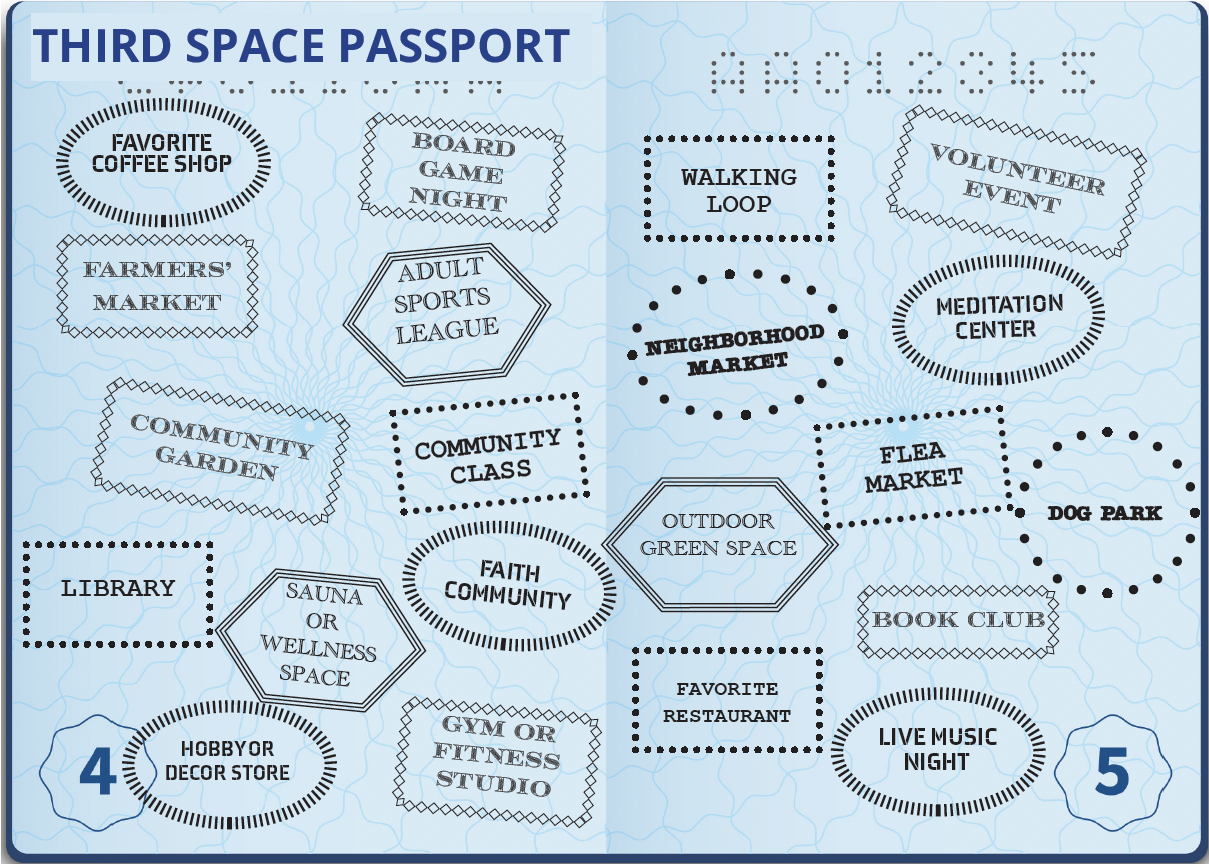
Which third spaces will you visit this month?

Heidi Roth RDN, LDN, is a Registered/Licensed Dietitian, Health Coach and nutrition expert with a passion for health and wellness. She graduated from the University of Pittsburgh with a BS in Nutrition and Dietetics.
May 2026 Corporate Newsletter: There's No Place Like Third Space
Tag(s):
Corporate Wellness Newsletters